From the monumental grandeur of the Sun Pyramid at Teotihuacan to the enigmatic, layered structure of the Circular Pyramid at Cuicuilco, the landscape of central Mexico is a palimpsest of ancient civilizations. These stone sentinels, rising from the highland plains, whisper tales of cosmic order, divine kingship, and societies that flourished and vanished long before the Aztecs gave these places the names we know today. To journey between them is to trace the evolution of Mesoamerican thought, architecture, and power across centuries.
The story begins not with the famous straight avenue of Teotihuacan, but further south, in the Valley of Mexico, at a place now swallowed by the lava flows of the Xitle volcano. Cuicuilco is one of the oldest ceremonial centers in the region, its origins stretching back to the Preclassic period, around 800 BCE. Its principal structure, the Circular Pyramid, is a profound anomaly in a world later dominated by quadrilateral temples. This great conical mound, built of river stone and earth, speaks of a different cosmological vision. While later pyramids represented sacred mountains reaching for the heavens, the circular form of Cuicuilco's pyramid may have been intimately connected to the worship of Huehueteotl, the old god of fire. The circular platform at its summit was likely a hearth for perpetual flames, a focal point for rituals that honored the elemental force that sustained life.
Walking around the base of the Cuicuilco pyramid today, with the modern sprawl of Mexico City visible in the distance, one can feel the profound sense of an ending. Around 100-200 CE, the Xitle volcano erupted, burying much of Cuicuilco under a thick layer of lava. This catastrophic event effectively snuffed out this early center of power. The disaster must have been apocalyptic for its inhabitants, but it also created a vacuum, a shift in the political and spiritual landscape. It is a compelling, though not definitively proven, theory that the decline of Cuicuilco contributed to the rise of its northern rival, Teotihuacan. As one civilization was entombed in rock, another was reaching its zenith.
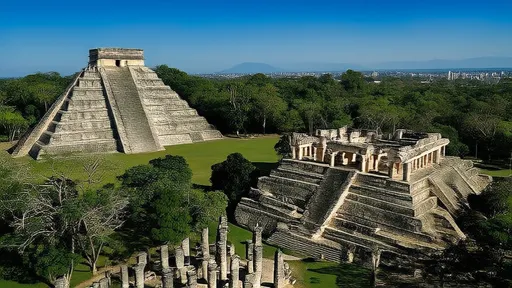
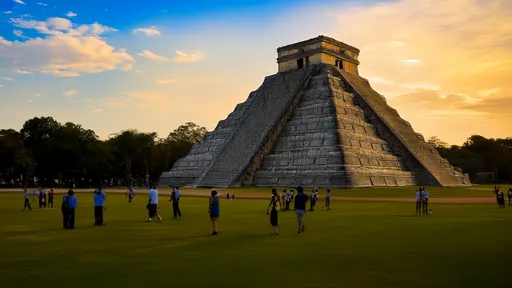
The ascent of Teotihuacan was meteoric. By the first century CE, it was growing into the first true metropolis of the Americas, a meticulously planned city that would, at its peak around 450 CE, house over 100,000 people. Its architects imposed a grand, geometric order upon the land, centering the city on the massive Street of the Dead. This causeway runs for more than two miles, flanked by platforms and smaller pyramids, all leading the eye toward the two colossal structures that dominate the horizon: the Pyramid of the Moon and, the undisputed heart of the city, the Sun Pyramid.
Where Cuicuilco's pyramid feels organic and earth-bound, the Sun Pyramid is a statement of sheer, calculated power. It is a perfect quadrangle, a man-made mountain of nearly three million tons of stone, brick, and earth. Its construction was an act of communal effort and sophisticated engineering on an almost unimaginable scale. The pyramid aligns with specific astronomical events; for instance, its western face directly fronts the setting sun on the days it passes the zenith. This was not just a temple; it was a cosmic engine, a place where the ruler, perhaps a priest-king, mediated between the earthly realm and the gods above and below. The scale of the pyramid was meant to overwhelm, to impress upon every visitor and resident the divine authority of the city's rulers and the cosmic order they maintained.
The contrast in form between the circular pyramid of Cuicuilco and the square-based pyramid of Teotihuacan reflects a deeper evolution in Mesoamerican society. Cuicuilco represents an earlier, perhaps more localized, form of social organization and religious practice, focused on elemental forces like fire. Teotihuacan, however, signifies the emergence of a state-level society with a complex bureaucracy, a stratified social hierarchy, and a pantheon of gods integrated into a more systematic and expansive cosmology. The quadripartite division of the world—the four cardinal directions—became a fundamental organizing principle, reflected in the city's layout and the shape of its greatest monuments.
Yet, for all its power, Teotihuacan's fate echoes that of Cuicuilco, albeit for different reasons. Around 550-600 CE, the great city experienced a violent collapse. Its ceremonial core was deliberately burned and sacked, and the metropolis was largely abandoned. The reasons remain a subject of intense debate—internal revolt, climatic change, invasion—but the result was the same: another great capital fell silent. The memory of Teotihuacan, however, never faded. Later cultures, most notably the Aztecs, who discovered the overgrown ruins, believed it to be the place where the gods created the current era of the world. They gave it the name we use today: Teotihuacan, "The Place Where the Gods Were Created."
The legacy of these two sites is a testament to the dynamism and fragility of ancient American civilizations. Cuicuilco, the older circular pyramid, stands as a monument to a world view that was ultimately superseded, its story cut short by geological catastrophe. Teotihuacan, with its Sun Pyramid, represents the flowering of that successor culture, achieving a level of urbanism and centralization that would not be seen again in the region for centuries. Its collapse left a power vacuum that would eventually be filled by the city-states of the Toltecs and later the Aztecs, who looked upon the ruins of Teotihuacan with the same awe we feel today.
To stand atop the Sun Pyramid and look south, toward where Cuicuilco lies buried, is to contemplate the long arc of history. One sees not a linear progression, but a cycle of creation and destruction, of innovation and memory. The stones of these pyramids are more than just archaeological relics; they are the physical manifestations of humanity's eternal quest to understand the cosmos and our place within it. They remind us that civilizations, however mighty, are transient, but the ideas they carve into the earth can endure for millennia, speaking across the ages to anyone willing to listen.
By /Sep 28, 2025
By /Sep 28, 2025
By /Sep 28, 2025

By /Sep 28, 2025

By /Sep 28, 2025
By /Sep 28, 2025
By /Sep 28, 2025
By /Sep 28, 2025

By /Sep 28, 2025
By /Sep 28, 2025

By /Sep 28, 2025

By /Sep 28, 2025
By /Sep 28, 2025
By /Sep 28, 2025
By /Sep 28, 2025

By /Sep 28, 2025
By /Sep 28, 2025
By /Sep 28, 2025

By /Sep 28, 2025
By /Sep 28, 2025
