Nestled in the southern expanse of Mexico City, the Ciudad Universitaria, or University City, of the National Autonomous University of Mexico (UNAM) stands as a monumental testament to the fusion of architecture, art, and urban planning. Declared a UNESCO World Heritage Site in 2007, this sprawling campus is far more than an institution of higher learning; it is a living museum, a canvas of the twentieth century where Mexico's brightest minds in architecture and muralism converged to create a unique and enduring symbol of national identity and modernity. The campus is not merely a collection of buildings but a holistic environment where the very walls speak of a nation's aspirations following the Mexican Revolution.
The genesis of University City in the early 1950s was a project of immense national importance. It represented a bold step into the future for a country eager to showcase its cultural renaissance and its commitment to public education. Under the direction of architects Mario Pani and Enrique del Moral, a team of over 60 architects, alongside renowned artists and landscape designers, embarked on an unprecedented endeavor. They were tasked with creating a modern university that was distinctly Mexican, breaking away from colonial and neoclassical traditions to forge a new aesthetic language. The result was a master-planned campus that integrated the principles of modernism with pre-Hispanic influences and the powerful social narratives of Mexican muralism, all set against the dramatic backdrop of the Pedregal lava field.
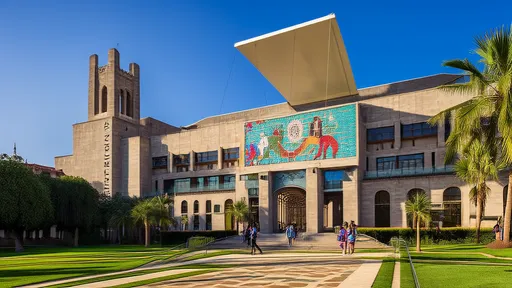
The architectural heart of the campus is the Central University Library, a towering structure designed by Juan O'Gorman. From a distance, the library appears as a colossal, colorful mosaic monolith. Its four façades are entirely covered with ten thousand square meters of natural stones arranged in mosaics that narrate the history of Mexico. The north façade depicts the pre-Hispanic era, the south façade the colonial period, the east façade the contemporary world, and the west façade the university itself. O'Gorman’s genius lay not only in the grand historical narrative but in the integration of the building's function with its art; the mosaics serve as an external skin, protecting the vast book collection within from the sun's rays. This building is arguably the most iconic symbol of the campus, a perfect synthesis of architectural form and artistic expression.
Adjacent to the library lies the Rectorate Tower, a sleek, ten-story building that houses the university's administration. Designed by Salvador Ortega, it is a masterpiece of functionalist architecture. However, its stark modern lines are transformed by the monumental murals created by David Alfaro Siqueiros, one of Mexico's great muralists. Siqueiros employed innovative techniques, using pyroxylin and automotive paints to create a dynamic, sculptural mural entitled The People to the University, the University to the People. The mural wraps around the building, creating a sense of movement and engagement, with figures that seem to emerge from and recede into the walls. This work embodies the democratic and populist ideals of the university, breaking the traditional two-dimensional plane of mural painting to involve the viewer and the architecture in a single, powerful dialogue.
The University Olympic Stadium, another cornerstone of the campus, is a feat of engineering and aesthetic vision. Built for the 1968 Olympic Games, its design by Augusto Pérez Palacios, Raúl Salinas Moro, and Jorge Bravo drew inspiration from ancient Mesoamerican volcanoes and temples. The stadium is carved directly into the natural rock of the Pedregal, with its massive volcanic stone stands blending seamlessly into the landscape. The crowning glory is the monumental relief mural by Diego Rivera that adorns the outside of the stadium's façade. Though Rivera passed away before its completion, his design, executed by others, depicts the history of Mexican sports intertwined with the iconic figures of the Aztec god Quetzalcóatl and a modern athlete, symbolizing the continuity of physical prowess from ancient times to the present.
Beyond these iconic structures, the campus is a labyrinth of artistic and architectural wonders. The School of Sciences building features a stunning mosaic by José Chávez Morado that represents the duality of life and death, a recurring theme in Mexican culture. The School of Medicine is adorned with a high-relief sculpture by Francisco Eppens that merges the faces of a man and a woman with an eagle and a serpent, reinterpreting the symbol on the Mexican flag. The Central Administration Building boasts murals by Carlos Mérida, whose more abstract compositions provide a counterpoint to the figurative narratives of his contemporaries. Walking through the campus is a continuous discovery, where every courtyard, faculty building, and even the signage, designed by Lance Wyman, contributes to a cohesive and immersive aesthetic experience.
The integration of the campus with its natural environment is a fundamental aspect of its design. The Pedregal lava field, with its unique ecosystem of endemic plants and rugged volcanic rock, was not simply cleared for construction. Instead, the architects incorporated it into the plan. The lava flow's contours dictate the layout of roads and plazas, and many buildings are positioned to respect the existing topography. The lush green spaces and the famous Espacio Escultórico (Sculptural Space), a massive circular earthwork created by a group of artists in 1979, further blur the line between the built and natural worlds. This large-scale land art piece, consisting of a circular walkway atop a volcanic stone wall surrounded by the natural reserve, invites contemplation on the relationship between art, nature, and cosmic cycles.
The World Heritage designation recognizes University City as an outstanding example of a collective masterpiece. It is a singular achievement of the twentieth century where the ideals of post-revolutionary Mexico—integration, education, national pride, and cultural synthesis—were given concrete form. The collaboration between architects and artists was not an afterthought but a foundational principle, resulting in a Gesamtkunstwerk, or total work of art. The campus remains a vibrant, functioning university, its buildings and artworks inhabited and used by students and faculty daily. This living quality ensures that the art and architecture are not frozen relics but active participants in the life of the community.
Today, the Universidad Nacional Autónoma de México campus continues to inspire awe and admiration. It stands as a powerful reminder of a period when architecture and public art were harnessed to build a national consciousness. For visitors, it offers an unparalleled journey through modern Mexican history and artistic genius. For the world, it is a benchmark of how educational spaces can be designed to uplift the human spirit, foster a sense of identity, and celebrate the enduring power of beauty and knowledge. It is, in every sense, a world heritage site not just of stone and pigment, but of ideas and aspirations.

By /Sep 28, 2025
By /Sep 28, 2025

By /Sep 28, 2025
By /Sep 28, 2025

By /Sep 28, 2025
By /Sep 28, 2025
By /Sep 28, 2025
By /Sep 28, 2025

By /Sep 28, 2025
By /Sep 28, 2025

By /Sep 28, 2025

By /Sep 28, 2025
By /Sep 28, 2025
By /Sep 28, 2025
By /Sep 28, 2025

By /Sep 28, 2025
By /Sep 28, 2025

By /Sep 28, 2025

By /Sep 28, 2025
By /Sep 28, 2025
