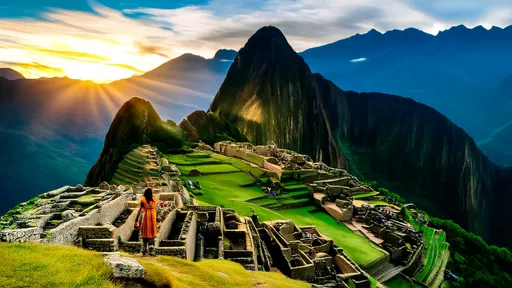
Beyond the iconic silhouette of Machu Picchu's stone terraces against the Andean sky lies a region of profound depth and ancient energy. While the "Lost City of the Incas" rightly claims the spotlight for any 2025 itinerary, focusing solely on its grandeur means missing the very heartland that nurtured the Inca Empire. The Sacred Valley, or Urubamba Valley, and the formidable fortress of Ollantaytambo are not mere add-ons; they are essential chapters in the story of this extraordinary civilization. To understand Machu Picchu, one must first walk through the living history of the valley that leads to it.
The journey into the Sacred Valley often begins from Cusco, the historic capital of the Inca Empire. As you descend from the city's high altitude, the landscape unfolds in a breathtaking panorama. The Urubamba River, a sacred vein of water the Incas revered as a reflection of the Milky Way, carves its way through a fertile plain flanked by staggering mountain peaks. This is not a passive landscape; it is an active, breathing entity. The Incas saw this valley as a divine creation, a place where the earth's energy was particularly potent. They engineered it with a mastery that still defines the terrain today. Vast agricultural terraces, built with an intricate understanding of hydrology and microclimates, cascade down the hillsides. These are not ruins in the static sense; many are still cultivated by local communities, a testament to the enduring brilliance of Inca design. The valley was the agricultural breadbasket of the empire, and its strategic location along natural corridors made it a crucial administrative and religious center.
Pisac, perched high on a mountain spur at the valley's eastern entrance, offers a staggering introduction to Inca urban planning. The site is a complex mosaic of military, agricultural, and religious structures sprawling across a vast area. The famed terraces of Pisac are some of the most extensive and elegant in the Andes, curving with the natural contours of the mountain like massive stairways to the sky. A hike along these terraces reveals the sophistication of Inca stonework, with precisely cut stones fitting together without mortar, resilient to the earthquakes that frequent the region. Above the terraces lies the Intihuatana sector, a ceremonial center with a temple of the sun and the iconic ritual stone, or "hitching post of the sun." This intricately carved rock functioned as an astronomical clock and calendar, allowing Inca priests to observe solstices and equinoxes with remarkable precision. The views from Pisac are unparalleled, offering a sweeping vista of the valley floor below, a patchwork of fields divided by the serpentine river.
Further along the valley, the charming town of Ollantaytambo feels like a portal to the 15th century. This is not just an archaeological site; it is a living Inca town. The original Inca cobblestone streets, canals, and dwellings are still in use today, making it one of the best-preserved examples of Inca urban layout. The town's layout is a marvel of planning, with narrow, straight streets channeling water through stone-lined canals. But the true spectacle lies above the town: the colossal Ollantaytambo Fortress. This was not merely a military stronghold but a complex temple, storage, and administrative center. The fortress's most awe-inspiring feature is the Temple of the Sun, a structure left tantalizingly unfinished after the Spanish conquest. Its six monolithic pink granite stones, each weighing over 50 tons, are fitted together with seams so tight a razor blade cannot slip through. The question of how these stones were quarried from a mountainside across the valley and transported up to this height remains one of archaeology's great mysteries. Climbing the steep terraces to the temple's platform is a physical challenge, but the reward is a profound sense of the site's strategic power, commanding the entire valley.
The genius of the Incas extended beyond monumental architecture into the very fabric of their relationship with the land. Throughout the Sacred Valley, one encounters Moray and Maras, two sites that exemplify this deep connection. Moray consists of several enormous natural depressions in the earth that the Incas sculpted into concentric circular terraces. This was likely an agricultural laboratory where they experimented with crops at different altitudes and microclimates, a stunning display of early scientific inquiry. Not far away, the salt pans of Maras create a dazzling, otherworldly landscape. Thousands of shallow pools, fed by a hypersaline spring, cascade down a mountainside. Harvested since Inca times, the pans are still operated by local families using methods passed down through generations. The contrast of the white salt pools against the red earth and green valley is a photographer's dream and a powerful reminder of the sustainable practices that sustained an empire.
For the traveler of 2025, experiencing the Sacred Valley and Ollantaytambo is about more than checking sites off a list. It is about immersion. This is a place to slow down. It is about staying in a valley town, waking up to the sound of roosters and the sight of mist-shrouded mountains. It is about sampling chicha, a traditional corn beer, in a local home. It is about hiking lesser-known trails that connect ancient sites, feeling the same earth underfoot as Inca messengers once did. It is about understanding that the journey to Machu Picchu is as significant as the destination itself. The Sacred Valley provides the context, the history, and the cultural depth that makes the final ascent to the citadel a truly transformative experience. You arrive not as a casual tourist, but as someone who has begun to comprehend the scale, intelligence, and spirituality of the world you are about to enter.
Planning your visit for 2025 requires a mindful approach. The Peruvian authorities, in a bid to preserve these fragile treasures, are implementing stricter visitor protocols, including timed entry and guided routes. This is a welcome change, promising a more sustainable and intimate experience. To truly absorb the magic of the Sacred Valley, allocate at least two to three full days. Use Ollantaytambo as a base for exploration; its location is ideal for accessing the fortress, Maras, and Moray, and it is the departure point for trains to Machu Picchu. Consider hiring a local guide whose knowledge can bring the stones to life with stories of Pachacutec, the Inca emperor who shaped this landscape. Engage with the communities, support local artisans, and tread lightly. The Sacred Valley is a gift from the past, and our responsibility is to ensure its stories echo for generations to come. When you finally board the train from Ollantaytambo towards Aguas Calientes, you carry with you the spirit of the valley, making your first glimpse of Machu Picchu not an introduction, but a glorious culmination.
By /Sep 28, 2025
By /Sep 28, 2025
By /Sep 28, 2025
By /Sep 28, 2025
By /Sep 28, 2025
By /Sep 28, 2025
By /Sep 28, 2025
By /Sep 28, 2025

By /Sep 28, 2025
By /Sep 28, 2025

By /Sep 28, 2025

By /Sep 28, 2025
By /Sep 28, 2025
By /Sep 28, 2025
By /Sep 28, 2025

By /Sep 28, 2025
By /Sep 28, 2025

By /Sep 28, 2025

By /Sep 28, 2025
By /Sep 28, 2025